


Age-gap relationships are more common than you might think. According to the data, most marriages in the U.S. have a small age gap. Especially if it’s a second marriage.
I’d say that age gap relationships are nothing unexpected in today’s day and age. Look at celebrity couples like Beyoncé and Jay-Z (12-year age gap), George Clooney and Amal Clooney (17-year age gap), and Blake Lively and Ryan Reynolds (11-year age gap).
While I’m not currently in an age-gap relationship, I can certainly see the appeal of dating someone older. They might be at a higher level in their career and bring a certain maturity to the relationship that allows me to grow.
On the other hand, I can also see the appeal of dating someone younger, who could help me get back in touch with the fun-loving parts of my personality that have faded a bit as I’ve gotten older.
1. Around 4 in 10 Americans Have Been in Age-Gap Relationships with a 10+ Year Difference
According to a recent Ipsos poll, many Americans have been in a relationship with someone who was at least a decade older or younger1 than they are.
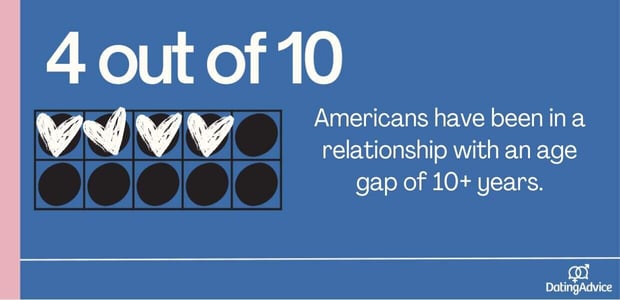
In the poll, 27% said they have previously dated someone 10+ years older, and 16% said they have previously dated someone 10+ years younger. Fewer said they are currently dating someone 10+ years older (4%) or 10+ years younger (6%).
2. In the Majority of Age-Gap Relationships, Men Are Older
I’m a woman, and I’ve dated someone 10+ years older than I was, but I’ve never dated someone 10+ years younger.
The data says that’s usually how it goes: Among respondents whose partners were 10+ years older, the older partner was more often male (63%) than female (36%).
Among respondents whose partners were 10+ years younger, 76% said their partner was female and 23% said their partner was male. This data suggests that while men are most often the older partner in an age-gap relationship, it’s not so rare for older women to date younger men either.
3. Same-Sex Spouses Tend to Have a Larger Age Gap Than Opposite-Sex Spouses
U.S. Census data collected in 2021 indicates that 20% of same-sex spouses2 have an age gap of 10+ years. That’s more than double the rate (8%) among opposite-sex spouses. Another 14% of opposite-sex couples and 20% of same-sex couples have an age gap between six and nine years.
4. One-Third of People Say 10 Years Is the Largest Acceptable Age Gap
A YouGov survey asked Americans their views on the largest acceptable age gap between romantic partners. Fifteen percent of respondents said four to six years3, 12% said seven to nine years, and 15% said 10 to 13 years was the maximum acceptable gap.
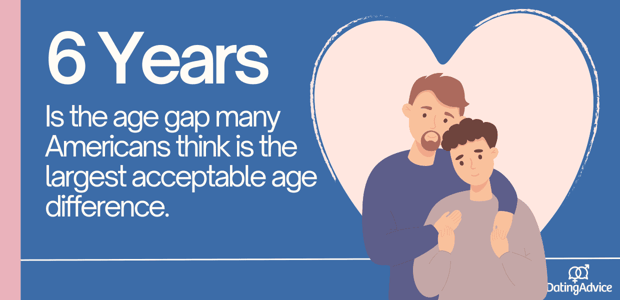
Five percent say a gap of 14 to 16 years is acceptable, 3% say a 17 to 19 year gap is fine, and 9% approve of a gap of 20 or more years.
5. Men Are More Likely Than Women to Say Age Gaps of 20+ Years Are Acceptable
About 9% in the YouGov poll said gaps of 20+ years were acceptable, with men (12%) twice as likely as women (6%) to hold this view. Meanwhile, 4% said romantic partners should be about the same age.
Not for nothing, but men are also more likely to report higher levels of satisfaction4 when in an age-gap relationship.
6. Second Marriages Are More Likely Than First Marriages to be Age-Gap Relationships
Men who are newly remarried (meaning they’ve been married at least once before and got married again within the past 12 months) are more likely than men in their first marriage to have a spouse who is significantly younger5 than they are.
About 20% of men in second marriages have a wife 10+ years younger. But only 5% of men in first marriages do.
7. Remarried Women Are More Likely to Have Younger Partners
Among newly remarried women, 11% have a spouse at least six years younger, compared to just 3% in first marriages. Among newly remarried women, 27% have a spouse who is at least six years older than they are; 18% of women in first marriages have a similar gap.
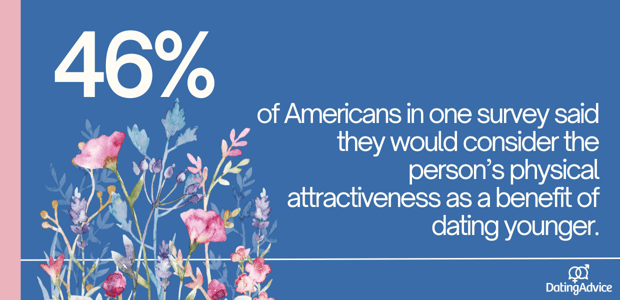
8. About 46% Agree Physical Attractiveness Is the Biggest Draw of Younger Partners
In the Ipsos poll, 46% said physical attractiveness was a benefit of dating someone 10+ years younger. Other perks included sexual energy (39%), open-mindedness (36%), and a “free spirit” (31%).
9. Nearly 60% Say Emotional Maturity Is a Benefit of Older Partners
59% of Americans in the Ipsos poll say an older partner’s emotional maturity would be a benefit when it comes to dating or marriage. Financial freedom (47%), professional success (41%), and sexual experience (28%) were also seen as positives.
10. Over 1 in 4 Say a Downside Is Not Having Anything in Common
About one-quarter (26%) of respondents in the Ipsos poll said they didn’t think they would have anything in common with someone who was at least a decade older or younger.
Fewer (17%) said they didn’t think they would be attracted to someone so much younger or older, and 16% said an age-gap partner wouldn’t fit in with their friends or family.
11. The Average Age Gap in the U.S. Is 2.2 Years
A Pew Research Center analysis of longitudinal data found the average age gap between couples varies by country and religion6, but women are typically the younger partner in those relationships across 130 countries and territories studied.
In the U.S. and China, the average age gap between couples who are married or cohabitating is 2.2 years.
12. Sub-Saharan Africa Has the Largest Age Gaps
Larger age gaps are more common in countries that are part of sub-Saharan Africa, per Pew Research Center. In Gambia, there’s an average of 14.5 years between men and their wives or partners; in Guinea it’s 13.5 years, and in Mali it’s 12.9 years.
13. Muslim Couples Have an Average Age Gap of 6.6 Years
Pew’s research found Muslims have the widest spousal age gap, with an average of 6.6 years between men and their wives or partners. Among Hindus, it’s 5.6 years. Christians have an average gap of 3.8 years, and Buddhists have one of just 2.9 years.
Jewish and religiously unaffiliated couples have the smallest average gaps: 2.1 and 2.3 years, respectively.
14. For Couples With Large Age Gaps, Marital Satisfaction Declines Quickly After 6 to 10 Years
A study published in the Journal of Population Economics found that couples with large age gaps reported higher satisfaction7 early in marriage. But after 6–10 years, satisfaction declined more quickly than it did for similarly aged couples.
FAQ: Which Dating Sites Are Best for Age-Gap Relationships?
If you’re looking to meet a match who’s significantly older or younger than you are, many popular dating sites allow filtering by age range.
Match is one well-established option, with over 15 million users across generations. The generational split is 32% millennials/Gen Z, 39% Gen X, 27% Boomers. The search filters make it easy to narrow by preferred ages.
AgeMatch is another dating site that’s worth mentioning. It’s specifically designed to bring together people of different ages, so you can feel comfortable knowing that everyone on the platform is non-judgmental about age-gap relationships.
The site has served more than 1 million users so far, largely in the U.S., Canada, and Australia.
How Much of an Age Gap is OK?
In my opinion, it really depends. An age gap of, say, 12 years is worth scrutinizing when one partner is 18 and one is 30. But if one partner is 40 and the other is 52, that feels fine.
It’s more about the stages of life that people are in rather than the age gap itself. Age gap relationships are only problematic when there’s a power imbalance and one partner is taking advantage of the other.
In general, you should look to date people who are in a similar life stage or have similar goals and values — regardless of their age.
What the Numbers Say About Age-Gap Relationships
Age-gap relationships are incredibly prevalent in the U.S. and around the world. While the dynamic of an older man and younger woman remains more common, plenty of successful couples are made up of an older woman and a younger man.
Of course, age and life stage can create potential challenges, but countless happy and devoted couples (including Keanu Reeves and his leading lady) prove that a significant age gap is not inherently a barrier to a successful relationship.
As the saying goes, age is just a number. These statistics reflect that for millions of people, love can conquer generational divides.
Data Sources:
- https://www.ipsos.com/sites/default/files/ct/news/documents/2024-02/Cougar%20Life%20Topline%20PDF%202.22.24.pdf ↩︎
- https://www.census.gov/library/stories/2023/08/same-sex-married-couples-age-race-ethnicity.html ↩︎
- https://today.yougov.com/topics/politics/survey-results/daily/2018/07/10/0f054/2 ↩︎
- https://www.psychologytoday.com/au/blog/the-asymmetric-brain/202506/age-gaps-in-relationships-which-partner-is-happier ↩︎
- https://www.pewresearch.org/short-reads/2014/12/04/tying-the-knot-again-chances-are-theres-a-bigger-age-gap-than-the-first-time-around/ ↩︎
- https://www.pewresearch.org/short-reads/2020/01/03/globally-women-are-younger-than-their-male-partners-more-likely-to-age-alone/ ↩︎
- https://www.ncbi.nlm.nih.gov/pmc/articles/PMC6785043/ ↩︎